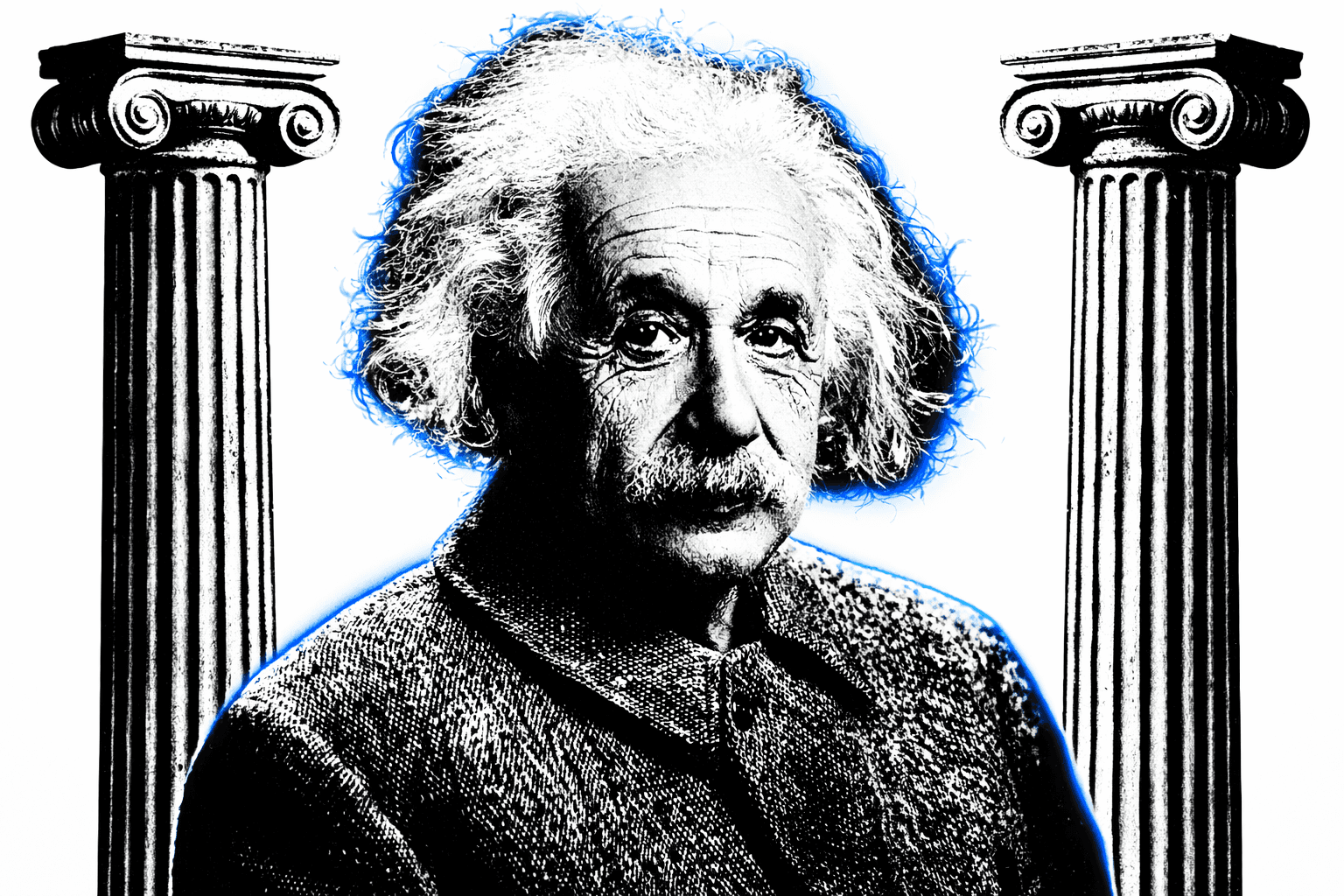
What if our idea of being a genius is completely backwards? And what if reclaiming the real meaning can connect us to a level of intelligence most of us have been ignoring our entire lives?
The term genius is used these days to describe exceptionally talented people. Einstein was a genius. Mozart was a genius. That one kid in college who aced every test was a genius. The term has turned into a label. It now describes those who think faster, score higher, and achieve more than most people. It is exclusive by its very definition, only applying to a select few people who excel.
But what if genius were never meant to exclude, but to unite? What if it wasn't even meant to describe a person in the first place?
The Origin of Genius
The original definition of genius was radically different from the one we use today.
The word "genius" has roots in ancient Rome. It comes from the Latin word "gignere," which means "to beget," "to bring into being," or "to give birth."
For the Romans, a genius wasn't a brilliant person. It wasn't a person at all.
It was a spirit.
A spirit that inhabited the walls of an artist's studio, the air of a town square, and the very bodies of the Roman people.
This spirit was the creative force behind your life. It was a guardian that shapes your nature and fuels your inspiration.
The genius was not you. It was something that worked through you.
Interesting side note: The Romans believed every man had a genius, while every woman had a spirit called a juno. They thought the genius was bigger and stronger. It's always good to bear in mind that ancient wisdom is only a hair's breadth away from either hypocrisy or bias. I say this to remind us that we're not trying to go back to old beliefs. Instead, we want to learn from the wisdom they offer.
The Greeks held a similar understanding. Socrates said he had a daimonion. This term originally meant a spirit or divine power that existed between gods and humans. It was neither good nor bad. It was a guiding force that helped Socrates make decisions and warned him of wrong choices. He did not describe it as a logical process or a calculated analysis. It was a signal—a knowing that came from somewhere deeper than thought.
As Christian writers translated Greek texts into Latin, they aimed to set theological boundaries. They needed to categorize the "pagan spirits" that Socrates often mentioned. In their belief, any supernatural being that wasn't God or an angel was seen as dark or fallen. So, the word daimon became daemon in Latin. Over time, daemon gained only negative meanings. By the time it passed into English as "demon," the original neutrality was completely gone.
In both Greek and Roman traditions, the message is clear: each of us has an inner intelligence. This intelligence isn’t just the result of our thoughts. It is something we receive, not something we manufacture.
The Collapse and Distortion of Genius
Sadly, the ancient's first insights into genius, or intuitive power, didn't last long.
In the 13th century, thinkers like Thomas Aquinas introduced more materialistic views to the world.
Aquinas separated human intelligence into two layers. The first was called ratio—the realm of step-by-step thinking, logical analysis, and argument. What we now call reason. The second layer was called intellectus: an immediate grasp of truth with no steps and no logic chain. Closer to what we would call intuition.
The catch with Aquinas was that even though he noted the existence of intuition, he didn't believe it was powerful enough on its own. He said it must be validated by reason, its more "adult" counterpart, to be seen as trustworthy.
This was a pivotal moment in the evolution of our understanding of consciousness. For the first time in Western thought, the direct intuitive realm of knowing valued by the ancients was pushed to a secondary role. Aquinas helped pave the way for the Enlightenment later on. This marked the slow decline in how we understand true genius.
Mankind Becomes The Center of The Universe
By the 1600s, Aquinas’ ideas had become established. Thinkers like René Descartes then introduced an even more materialistic view of the world. Descartes, after reflecting on the question "What can I know with absolute certainty?" gave his answer with the blockbuster declaration that lives on to this day:
"I think, therefore I am."
It is no wonder his ideas spread like wildfire. Descartes was giving the world a reason to feel in control of their reality. What part did intuition or God have in a world where you could think your way to self-knowledge?
Through his work, Descartes effectively simplified and domesticated intuition, relegating it to the category of gut feeling: irrational, unreliable, and emotional.
As a result, as the years of the Enlightenment unfolded, the source of creation and inspiration in human beings began to be attributed to the person rather than the spirit driving the person. We moved from "she has genius" to "she is a genius." By the 18th and 19th centuries, genius had become synonymous with individual brilliance rather than the ability to create and tap into deep wells of knowledge that goes beyond reason.
This shift in our understanding of genius did two things. First, it internalized creativity—in other words, it was no longer the spirit doing the creating. It was you. And second, it created pressure to be creative or exceptional instead of being open to receiving inspiration.
Have you ever been put on the spot to be creative? Maybe you had to introduce yourself to a group with a fun fact and… nothing came to mind. Or you were asked last-minute to give a presentation at work. Or back in middle school, you were pressured to be in the talent show.
How did you perform in those scenarios? Did you feel a wellspring of creativity burst forth, fueling a flow of ingenious performance that your friends or colleagues were stunned to receive?
Or did you get nervous, start shaking, and maybe quit altogether?
Humans aren't built to be creative on demand. They struggle even more with pressure and high stakes. The most talented musicians still rehearse their songs, over and over again, before getting in front of an audience. And even they need years of experience before they can be expected to improvise on the spot.
The point is—moving the genius from outside of us to inside of us introduces major issues. In her TED talk, Elizabeth Gilbert explains how Romans' idea of genius protected artists. Externalizing inspiration helps artists avoid becoming too narcissistic when their work gets praised. It also prevents them from sinking into depression when their work isn’t well received.
During the rise of materialism through the Enlightenment, both of these areas of protection were lost. You didn't have a genius, you had to be a genius.
It took about a hundred years for people to start pushing back.
The Intuitive Renaissance
About a century after the Enlightenment, artists and thinkers became tired of the growing materialism in society.
They started to rebel, bringing back intuition with the Romantics. This included figures such as William Blake, Samuel Taylor Coleridge, and Johann Wolfgang von Goethe. Goethe captured the movement well with his words: "We see only what we know." This highlights how our senses are limited and shows the value of considering what we can’t see.
Despite their best efforts, however, "original genius" and intuition stayed strictly within the boundaries of art, poetry, and spirituality. It had no place in the world of properly-thinking humans.
The timely birth of psychology
Just when it seemed inspiration was fading, two giants emerged. They both changed how we understand consciousness forever.
Their names were Sigmund Freud and Carl Jung.
Freud established himself as the architect of the unconscious mind. Jung established the clinical realm of meaning and personal expansion. Remember Thomas Aquinas’ claim that intuition needed reason in order to be trusted? These two were the first to show that intuition is a valid form of knowledge—no less important than reason.
Freud and Jung focused on the unconscious mind as central to psychology. They saw humans as mostly unconscious and only slightly aware. This view suggested that people aren't fully in control of their decisions. This was the exact breath of life that the concept of intuition needed at the time.
(The funny and fascinating part is that the same materialistic thinking which drove Aquinas and Descartes to shun genius and intuition was now being used by Jung and Freud to justify its existence.)
Nobody could argue with these two scientists' findings. Depth psychology went mainstream, and other fields like marketing and politics followed suit over the years.
As genius and intuition sank their roots of legitimacy into the field of psychology, a wave of research followed. In the hundred years since Freud and Jung, we've learned a lot about the human mind. Yet, scientists agree there's still much we don't understand.
…But we still know a lot.
We know the brain decides before you do
What if your decision-making process is mostly an afterthought?
In a 2000s study, participants chose between left and right while lying in an MRI machine. The study found that their brain patterns predicted their choice up to seven seconds before they consciously knew what they had decided.
Seven seconds.
The decision formed unconsciously, and awareness came seven seconds later. This raises many questions about what affects our decisions. It also makes us wonder how much of this process we truly notice.
What’s happening below the surface of our subconscious minds that takes seven seconds to reach our conscious awareness? What biases affect us? How do limiting beliefs cloud our decisions, often without us realizing it?
These are questions that must be investigated; if not to get an answer, then to simply highlight the paramount importance of asking questions that challenge our worldviews and the biases we unknowingly hold.
We know the body knows before the mind catches up
Your conscious mind follows your subconscious mind. Similarly, your subconscious follows and is deeply influenced by your body and emotions.
The Iowa Gambling Task, led by neuroscientist Antonio Damasio, showed that bodily signals—like heart rate, sweat, and muscle tension—help guide our decisions. These signals can be very accurate when our reasoning fails.
Participants sat in front of four decks of cards and were told to pick cards to earn rewards. They didn't know that two decks had big rewards but even bigger losses. The other two decks had smaller rewards and smaller losses. Participants started to show signs of unease over time. They had sweaty palms and an elevated heart rate when reaching for the risky decks.
This finding is fascinating. You might expect the reasoning mind to notice the difference between the decks first. But that’s not what happened. The subconscious mind or body noticed the pattern first. It recognized something was wrong with the riskier decks before the conscious mind did.
Damasio called these somatic markers. These are signals from the body that hold the emotional effects of past experiences. These markers help us make future decisions. His work suggests that what we call gut feeling is not a vague hunch. It is a sophisticated processing system that runs faster than deliberate thought.
Fast thinking, slow thinking
Psychologist Daniel Kahneman’s research in Thinking, Fast and Slow shows that our minds operate in two ways. He explained two modes of thinking: System 1 is quick, instinctive, and automatic. System 2 is slow, thoughtful, and conscious. Intuition lives in System 1—the realm of rapid insight and decision-making.
Remember Aquinas’ claim that intuition needed to be validated by reason in order to be trustworthy? Kahneman's research tells a different story. It shows that our body and unconscious mind help make decisions. Often, they find the right answer before our conscious thinking kicks in.
This is why certain people exhibit lightning-fast reaction times to high-risk situations, such as in extreme sports or in dangerous scenarios. Most of our lives rely on System 2 thinking. This is slow, rational, and deliberate. But when things get tough or you're in a flow state, System 1 takes over.
There's slow thinking and then there's flow thinking
Steven Kotler is the founder of the Flow Research Collective. One of his passions is writing about the flow state. This includes books like Rise of Superman and The Art of Impossible.
Kotler describes the flow state as one of ease and instantaneous insight. He says that when you're in flow, time slows down. Decisions feel easy and you know exactly what to do at every moment. It's a state of extreme focus which often results in the accomplishment of extreme feats of performance or insight.
Kotler was first drawn to flow because of those extreme feats. He followed and wrote about extreme athletes for work. Over time, he noticed some of them entered an altered state of consciousness—called flow—while engaged in their sport. After some research, it turned out that people in business were able to get into this state, too—and the world has been starting to catch up since then.
But slowly.
A strange liminal moment
We are at an odd point in history. Research into flow and neurobiology has begun to quantify how intuitive processing functions in the brain. High performers in all fields—athletes, entrepreneurs, artists, and military operators—use it all the time. Kotler found that peak performance relies on stepping away from analytical thinking. Instead, it comes from entering a state of easy, intuitive action triggered by specific factors.
And yet most people still do not trust their own intuition. The pattern is almost universal: you feel something is right. Then you overanalyze it. Then you delay. Then you miss the opportunity.
So what gives? Why the gap between what we know and how we live? The evidence is clear: we perform better when our intuition and our reason are in sync with one another. We make better decisions, we're less stressed, and we perform at our highest potential.
What's holding things up?
We Haven't Completed The Cycle—Yet.
We live in a time when we grasp our conscious minds better than ever. But now, we also explore the vast depths of our unconscious. With scientific tools, we can look into it, rewire it, and enhance our lives in ways that would amaze thinkers like Freud.
Trace the arc and the pattern of our evolved awareness is unmistakable. In the ancient world, intuition was sacred. Aquinas made it secondary. Descartes redefined it into logic. The Romantics revived it emotionally. Psychology internalized it. And now, in the modern era, intuition has been validated—but it is still inconsistently trusted.
We are moving into an era in which intelligence and intuition aren't thought of as separate modes of thinking. Intelligence itself will be the symbiosis of the two sides—one plus one equals three. This will lead to a level of human intelligence superior to what we'd achieve using either system alone.
This offers a big chance for high achievers seeking an advantage in business. It also appeals to those on a personal growth journey who want a more balanced mindset and lifestyle.
We are nearing the end of a millennia-old cycle: reconnecting with our mind and our intuition. We're entering a period of re-cognition, in the truest sense of the word, of the true capabilities of our minds.
Getting in Touch With Our Intuition
In a rare agreement between science and ancient teachings, when we ask the question of "how do we feel our intuition?" we get the same answer from all sides:
You have to remove the noise.
Research supports this connection. The HeartMath Institute's research, spanning over twenty-five years, shows that the heart sends more signals to the brain than vice versa. These signals directly impact our intuitive awareness.
Their research shows that breath work and emotional regulation techniques strengthen this connection. They also boost intuitive capacity.
Neuroscience research shows that the brain's default mode network (DMN), which handles mind-wandering, daydreaming, and worry, quiets significantly during meditation.
In other words, the noise can be turned down. And when it is, the signal from our intuition gets clearer.
Ancient traditions reached the same conclusion through a different path. Taoists see stillness as essential for action: the empty space in a pot makes it useful. As Lao Tzu wrote in the Tao Te Ching:
“Do you have the patience to wait till your mud settles and the water is clear?”
Different language, different era, same insight. No matter if you're pointing at a brain scan or a verse from long ago, the truth is the same: clarity isn’t something you create. It is what remains when the interference is removed.
The One Thing: Remove The Interference
You only have one thing to do if you want to get in touch with your intuition: remove the interference from your mind.
Imagine you are hiking in the woods. You have a map, but in order for the map to make sense, you need a compass. Your reasoning mind is the map, and your intuition is the compass. The map is clear and precise, and the compass seems to shift every time you move—but it always points north.
Or does it?
Let's say that when you weren't looking, before you left for your hike, someone put a bunch of magnets in your backpack. You have no idea they’re there, but you've been carrying them the whole time.
As long as those magnets are in your backpack, your compass is gonna point in the wrong direction. There's too much interference. The compass won't be broken, but also won’t point north—until you take the magnets out of your bag and walk away.
In the same way that we each have a map (reasoning mind) and a compass (intuitive mind), we also all carry magnets around in our backpacks.
The magnets can show up as childhood trauma, limiting beliefs, and financial stress. They also look like career stress, relationship issues, insecurity, sickness, anxiety, and depression. All these distractions can block the subtle signals your intuition tries to send you.
Meditation, therapy, and the psychological work of Jung and Freud all matter for this reason. It is also why psychedelic-assisted therapy is gaining so much ground. These tools can turn down the noise and remove the interference so you can finally listen to the signals your body and intuition are sending you.
Signals like:
Don't work with this person—EVER
Take the long way home from work today
You shouldn't eat that
Call that old friend you haven't seen in awhile
I speak from experience. My own journey involved using a combination of tools to remove the noise from my own head. As I remained committed to resolving my baggage and healing my wounds, the noise slowly started to subside, and I began getting these little "intuitive hits" that ended up having weird outcomes, like:
That person you didn't end up working with gets arrested for tax fraud
There was a huge backup on your normal way home from work
You find out you have an undiagnosed allergy
That old friend was thinking of you, too—and is needing support during a hard time
If you want to feel your genius—your intuition, the intelligence that is yours by birth—then a good place to start is removing the noise. You do not need to become a genius. You already "have" one.
All that is left is to quiet the noise long enough to hear it.